Exhibit 02
History of Saves & Checkpoints
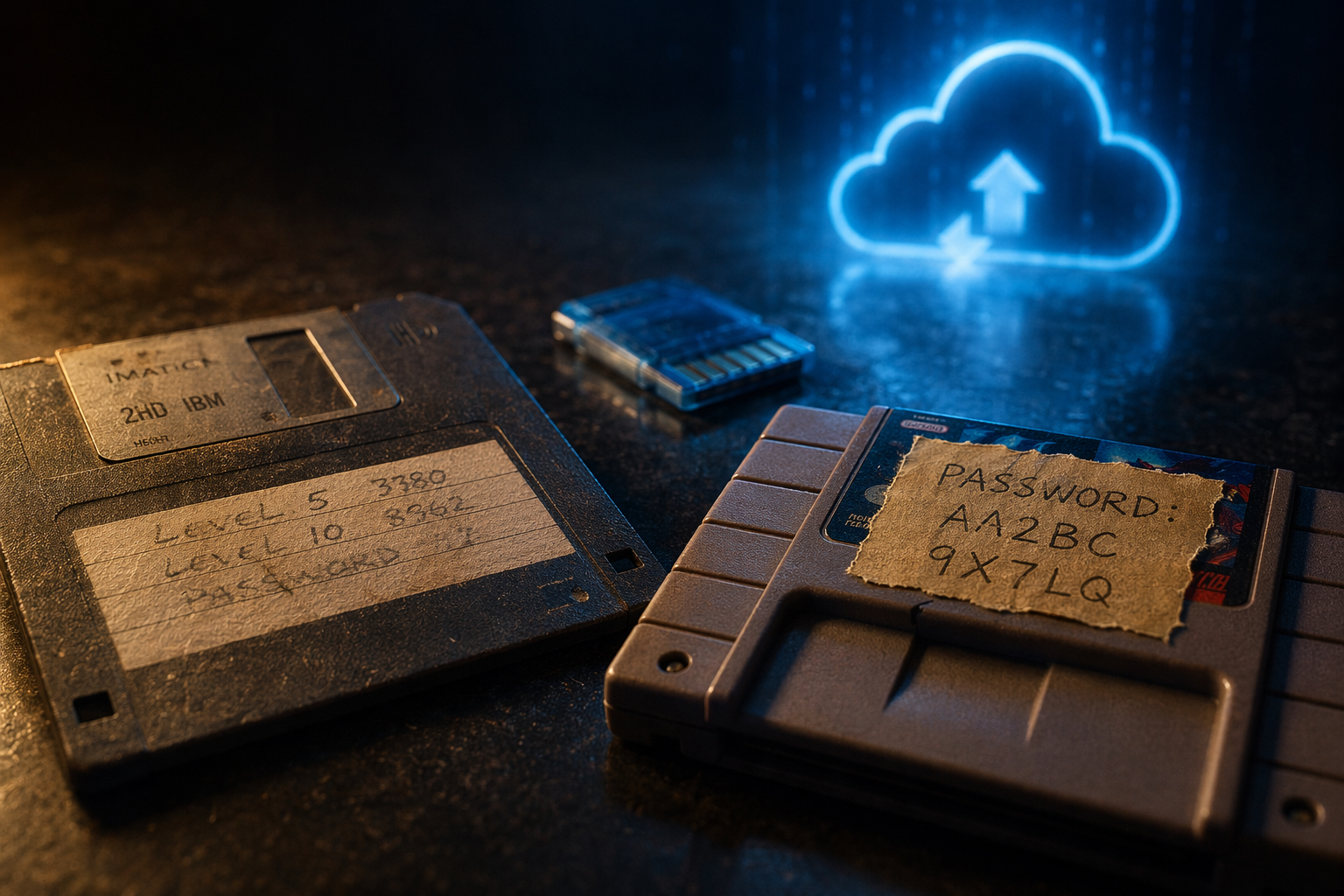
The remarkable journey from scribbling passwords on notebook paper to seamless cloud synchronization across devices.
The remarkable journey from scribbling passwords on notebook paper to seamless cloud synchronization across devices.
Before battery-backed save RAM existed, games had a problem: cartridges couldn't store progress. The solution was elegant in its simplicity — give players a code. Write it down. Come back later, enter the code, and pick up where you left off.
Games like Mega Man (1987) used password grids where you'd mark specific positions. Metroid gave you a 24-character alphanumeric string. Some passwords became legendary — like "JUSTIN BAILEY" in Metroid, which wasn't a cheat but a happy accident of the encoding system.
While not a true save, the game's hidden rooms represented the first attempt at persistent secrets in console gaming.
Nintendo's gold cartridge contained a lithium battery that maintained save data. For the first time, console players could save and quit without losing everything.
Sony's removable memory cards let players carry saves between consoles and manage storage. The 15-block limit forced painful decisions about which saves to keep.
Automatic checkpoints eliminated manual saving in action games. Players could focus on the experience without worrying about save management.
Constant autosaving meant every action was permanent. Death had consequences. You couldn't reload to undo mistakes. The save system became the game's philosophy.
Steam Cloud, PlayStation Plus, Xbox Cloud — your progress follows you across devices. Start on PC, continue on your phone, finish on your console.
Quicksave/Quickload (PC Gaming): The ability to save anywhere, anytime, fundamentally changed how players approached challenges. Some argue it reduced tension; others say it enabled experimentation.
Roguelikes & Permadeath: Games like Spelunky and Hades deliberately remove traditional saves. Death means starting over — but the knowledge you gained persists in your mind, creating a different kind of progression.
The Soulslike Approach: From Software's games save constantly but never let you undo. This creates a unique tension where every decision matters because you can't take it back.
Narrative Saves: Games like Undertale remember your choices even after you reset. The save system becomes part of the story, breaking the fourth wall in unsettling ways.