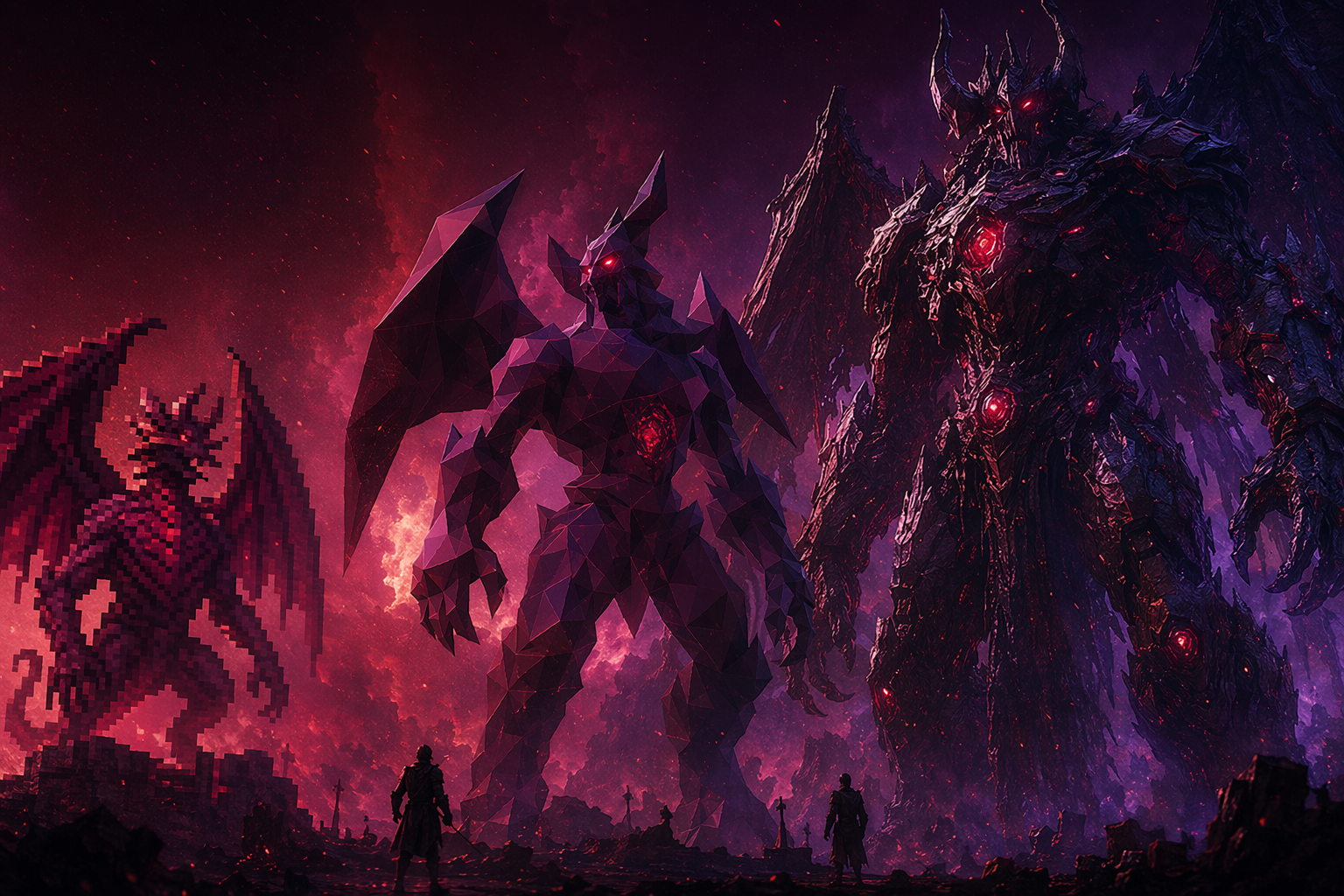
Exhibit 04
Boss Design Through the Ages
From the first oversized enemy sprite to multi-phase cinematic spectacles — how bosses became gaming's most memorable moments.
From the first oversized enemy sprite to multi-phase cinematic spectacles — how bosses became gaming's most memorable moments.
The earliest bosses were defined by hardware limitations. They were bigger than regular enemies — sometimes taking up a quarter of the screen — and they moved in predictable patterns. Space Invaders (1978) had its mothership. Galaga (1981) had its challenging stages. These weren't true bosses in the modern sense, but they established the concept: a special, more difficult enemy that marks progress.
The real boss fight was born in beat-em-ups and early platformers. Games like Kung-Fu Master (1984) placed a unique enemy at the end of each floor — each with a distinct attack pattern that players had to learn and counter.
Each floor ended with a unique enemy. Players learned patterns through repetition. Death was expected — mastery was the reward.
Each Robot Master was weak to another's weapon. Boss order became a meta-puzzle. Players strategized before the fight even began.
When your opponent is human, every fight is a boss fight. Street Fighter proved that the best "AI" is another player — unpredictable, adaptive, and infinitely challenging.
Zelda bosses required dungeon items to defeat. The boss wasn't just a health bar — it was a puzzle that tested everything you'd learned in the dungeon.
The entire game was boss fights. Each colossus was a living puzzle — a mountain to climb, a riddle to solve, and a moral question to answer.
Multi-phase fights, minimal telegraphing, punishing difficulty. FromSoftware redefined what a boss fight could be — a test of patience, observation, and perseverance.
Readable Attacks: Great bosses telegraph their moves. A wind-up animation, a color change, a sound cue. Players need to feel that death was their fault, not the game's.
Escalating Phases: Modern bosses transform mid-fight. New attacks, new arenas, new music. Each phase raises the stakes and tests different skills. The player who mastered phase one must adapt again for phase two.
Narrative Weight: The best boss fights carry emotional significance. Fighting a former ally, confronting a philosophical opposite, or facing the consequences of your choices — story elevates combat into drama.
The Victory Moment: A great boss makes you feel like a god when you finally win. The harder the fight, the sweeter the triumph. This is why players voluntarily subject themselves to dozens of deaths — the payoff is worth it.