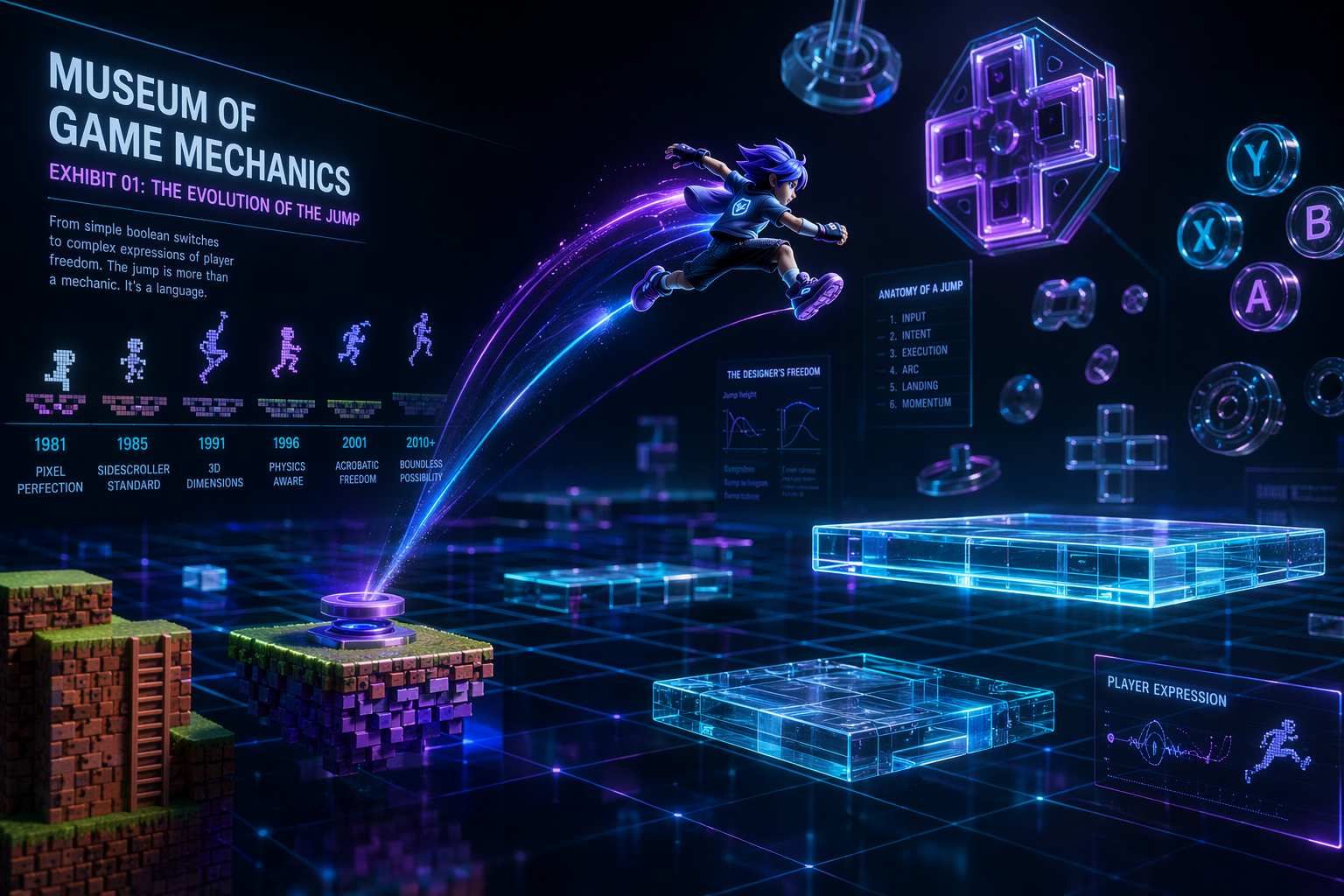
Exhibit 01
Evolution of the Jump
From a single button press in 1981 to the most nuanced movement system in modern gaming — the jump is where it all began.
From a single button press in 1981 to the most nuanced movement system in modern gaming — the jump is where it all began.
In 1981, Nintendo released Donkey Kong — and with it, the platformer was born. Jumpman (later known as Mario) could do exactly one thing that mattered: jump. It was a fixed arc, no air control, no variable height. You pressed the button, and the character followed a predetermined path through the air.
This simple mechanic was revolutionary. Before Donkey Kong, most arcade games were about shooting or navigating mazes. The jump introduced verticality, timing, and spatial reasoning to gaming in a way nothing else had.
Fixed arc, no air control. Simple but groundbreaking. Players learned to time their jumps to avoid barrels and climb ladders.
Hold the button longer, jump higher. This single innovation gave players unprecedented control and made platforming feel expressive rather than mechanical.
Jump height affected by running speed. Sonic introduced physics-driven platforming where the jump wasn't isolated — it was part of a continuous flow of movement.
Triple jump, wall jump, long jump, backflip. Mario's move set exploded into three dimensions, proving that the jump could be just as satisfying without a fixed camera angle.
Momentum conservation through portals turned the entire concept of jumping on its head. Falling became jumping. The floor became the ceiling.
Dash, climb, wall jump — with coyote time, jump buffering, and assist mode. Celeste proved that extreme difficulty and accessibility could coexist through thoughtful jump design.
Coyote Time: Most modern platformers give you a few extra frames to jump after walking off a ledge. Named after Wile E. Coyote's famous delayed falls, this invisible grace period makes games feel fair without players ever knowing it exists.
Jump Buffering: Press the jump button slightly before landing, and the game remembers your input and executes the jump the moment you touch ground. Without this, fast-paced platformers would feel unresponsive.
Variable Gravity: Many games apply different gravity values during the rising and falling phases of a jump. Faster falling makes jumps feel snappier and more responsive, even if the actual jump height stays the same.
Corner Correction: When you barely miss a platform edge, some games subtly nudge your character onto it. This prevents frustrating near-misses and keeps the flow of gameplay smooth.